

A Journey Through 10 Extraordinary Ancient Engineering Marvels
Introduction
Imagine traveling thousands of years into the past, to a world without electricity, computers, satellites or modern machinery. Now imagine discovering that the people who lived there had already developed sophisticated mechanical devices, extraordinary construction techniques and scientific instruments that still fascinate researchers today.
Across ancient civilizations, ingenious minds transformed simple materials into remarkable technologies. Some of their inventions were centuries ahead of their time, while others have left behind questions that continue to inspire scientific investigation.
Join us on this fascinating journey across continents and civilizations as we uncover ten extraordinary ancient technologies that challenge our understanding of human innovation.
1. The Antikythera Mechanism – Greece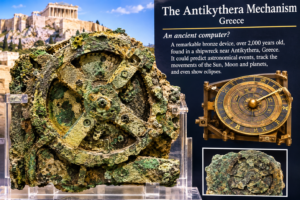
Our journey begins beneath the waters near the Greek island of Antikythera, where divers discovered a mysterious mechanical device inside an ancient shipwreck. Dating to around the second century BC, this intricate arrangement of bronze gears could calculate astronomical positions and predict eclipses. Often described as the world’s earliest known analogue computer, its sophistication reveals just how advanced ancient Greek mathematics and engineering had become.
Transition: But while the Greeks were calculating the movements of celestial bodies, another ancient civilization was developing something equally remarkable: a building material capable of surviving for thousands of years.
2. Roman Concrete – Rome
The Romans developed a unique concrete using volcanic materials, producing structures that have endured for centuries. Modern researchers continue investigating its remarkable durability and self-healing properties. The engineering principles behind this material remain relevant to modern construction.
Transition: From extraordinary architecture, we move into the world of ancient metallurgy, where craftsmanship transformed ordinary metals into legendary weapons.
3. Damascus Steel – Middle East
Renowned for its distinctive patterns, strength and sharpness, Damascus steel became legendary among medieval warriors. Although modern science understands much about historical steel production, reproducing the precise characteristics of some original blades remains challenging.
Transition: Yet metal was not the only material ancient civilizations learned to manipulate in extraordinary ways. Some developed weapons that seemed almost impossible to defeat.
4. Greek Fire – Byzantine Empire
Used by the Byzantine Empire, Greek fire was a terrifying incendiary weapon capable of continuing to burn on water. Its exact chemical composition remains uncertain, making it one of military history’s most fascinating technological mysteries.
Transition: Leaving the battlefields behind, we travel east to examine an unusual archaeological discovery that has sparked decades of debate about ancient electricity.
5. The Baghdad Battery – Ancient Mesopotamia
This mysterious clay vessel contained a copper cylinder and an iron rod. Some researchers believe it could have generated electricity when filled with an acidic liquid. However, there is no convincing evidence that it was historically used as a battery.
Transition: Whether or not this object was electrical, ancient ingenuity is undeniable. Nowhere is that more evident than in the extraordinary stone monuments of ancient Egypt.
6. Egyptian Stone Working – Ancient Egypt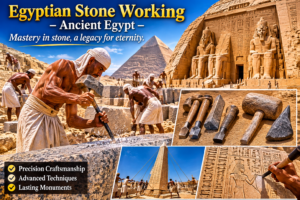
The pyramids and enormous granite monuments demonstrate exceptional knowledge of measurement, stone cutting, transportation and construction. Although many techniques are understood, the organization and logistics behind these monumental projects remain fascinating subjects of research.
Transition: From engineering massive structures, we turn to a civilization that developed an entirely different scientific instrument: a device designed to detect earthquakes.
7. Zhang Heng’s Seismoscope – Ancient China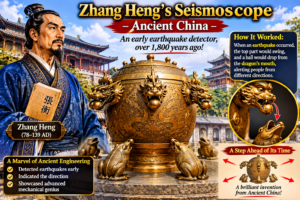
Created around AD 132, this remarkable instrument reportedly detected distant earthquakes and indicated their direction through an ingenious mechanism involving decorative dragons and metal balls. It represents an extraordinary early contribution to earthquake observation.
Transition: Understanding the movement of the Earth was one challenge; understanding the movement across its oceans was another. This brings us to the remarkable achievements of ancient navigators.
8. Ancient Navigation – Across Civilizations
Long before GPS and modern navigation systems, sailors relied on stars, ocean currents, winds and environmental observations. Polynesian navigators, in particular, mastered remarkable techniques for crossing vast stretches of the Pacific Ocean.
Transition: But navigating the oceans was only part of humanity’s relationship with nature. Ancient societies also had to control one of life’s most essential resources: water.
9. Ancient Water-Management Systems – Across the World
From Roman aqueducts to Persian qanats and ancient irrigation networks, civilizations developed sophisticated systems for transporting and distributing water. Some of these structures still function today, demonstrating remarkable engineering and environmental understanding.
Transition: And if controlling water across enormous distances was impressive, the ability to organize, measure and construct monumental structures without modern machinery deserves equal admiration.
10. Ancient Monumental Engineering – Across Civilizations
Stonehenge, the Egyptian pyramids and the extraordinary stonework of the Inca reveal impressive planning, measurement and material-handling skills. These achievements demonstrate that sophisticated engineering existed long before modern industrial technology.
Conclusion: Separating History from Mystery
The ancient world was neither technologically primitive nor scientifically identical to our modern age. Archaeology and scientific research have explained many of its extraordinary achievements, while others still contain unanswered questions.
It is important to distinguish established historical evidence from speculation. Not every mysterious artefact represents lost advanced technology, but every genuine discovery offers an opportunity to understand human ingenuity.
Perhaps the greatest mystery is not how ancient people achieved these extraordinary things, but how much more there is still to learn about the intelligence, creativity and ambition of our ancestors.
The past is not simply history. It is a remarkable record of human innovation, and its greatest lessons may still lie beneath our feet, buried in forgotten cities, ancient ruins and unexplored waters.